News & Activities

The Decade of Possibilities in the Low Countries (1566–1581) International online research seminar Academic year 2026/27

18-09-2026 – Political Experiments and Ideas of Change
•

Judith POLLMANN (Leiden University), How to End the Dutch Revolt? International Future-Thinking in Action
•
Jonathan DUMONT (Liège University), A Monarchical Utopia? Maximilien Vilain and the Compromise Monarchy
13-11-2026 – Religious Alternatives
•
Christine KOOI (Louisiana State University), The Reformed International in the Low Countries in 1572
•
Guido MARNEF (University of Antwerp), A Road to a Multi-Religious Urban Society or to Religious Monopoly?

22-01-2027 – Diplomacy and News
•
Nina LAMAL (Huygens Institute, KNAW), The Diplomatic Campaigns of 1577-1578
•
Monique WEIS (University of Luxembourg), Political Discourse about War and Peace in Two Rival discours véritables about the Dutch Revolt (1577)

19-03-2027 – Visual Discourses
•
Cassiopée GUILLET (University of Paris I Panthéon-Sorbonne), Visualizing Oppression: Protestant Prints and the Rhetoric of Violence in the Early Modern Low Countries (1566-1581)
•
Anne-Laure VAN BRUAENE (Ghent University), Badges of Authority. Heraldry and the Display of Civic Republicanism in Calvinist Ghent

21-05-2027 – War and Army
•
Raymond FAGEL (Leiden University), The First Decade of the Revolt in the Low Countries: from Spanish Soldiers to Spanish Occupation
•
Michael DEPRETER (Saint-Louis-UCLouvain/University of Oxford), Arms Markets, “Military Revolution”, and Socio-Political Identities in the Low Countries’ Urban Republics (1577-1585)

Each session begins at 1:30 pm and finishes at 3:30 pm
Organisers: Anne-Laure VAN BRUAENE (Ghent University), Jonathan DUMONT (Liège University), Monique WEIS (University of Luxembourg)
Registration and information:
jonathan.dumont@uliege.be 18-09-2026 – Political Experiments and Ideas of Change

‘a href=”https://www.iemh.be/wp-content/uploads/2026/06/Decade-of-Possibilities.pdf”>Decade of Possibilities

CfP: Jaarcongres Werkgroepen Zeventiende en Achttiende Eeuw en VNVNG: Vroegmoderne Ecologieën

Dit jaar op 4 september organiseren de Werkgroep de Zeventiende Eeuw, Werkgroep de Achttiende Eeuw en de VNVNG voor het eerst samen een jaarcongres, met als thema Vroegmoderne Ecologieën. Het doel is de bredere vroegmoderne gemeenschap bijeen te brengen en gedachten uit te wisselen over de complexe relaties tussen mensen en niet-mensen binnen ecologische netwerken in de vroegmoderne periode (ca. 1500–1850), en de representaties daarvan.

Hoe verhielden vroegmoderne menselijke samenlevingen zich tot natuurlijke bronnen, landschappen, niet-menselijke dieren en planten? Welke ideeën bestonden er over evenwicht, duurzaamheid, verstrengeling, uitbuiting en extractie? En hoe werden deze ideeën verbeeld in literatuur, kunst, ambacht, filosofie, wetenschap, religie, recht en politiek?

Ze verwelkomen bijdragen die ecologie breed opvatten en aandacht hebben voor zowel materiële als discursieve praktijken. Zowel casestudy’s als theoretische of methodologische reflecties en voorstellen voor paneldiscussies zijn welkom. Mogelijke invalshoeken zijn:

  • stedelijke en rurale ecologieën
  • koloniale en globale ecologische netwerken
  • klimaat(verandering) en weerservaringen
  • landbouw en voedselvoorziening
  • omgang met ziekte, vervuiling en afval
  • relaties tussen mensen, niet-menselijke dieren en planten
  • archivering en kennisproductie van de natuurlijke omgeving
  • artistieke en literaire representaties van landschappen, dieren, en planten
  • natuurhistorie en verzamelingen
  • de rol van instituties en macht in ecologische ordeningen

Het congres staat open voor beginnende en ervaren onderzoekers uit verschillende disciplines, waaronder (maar niet beperkt tot) literatuurwetenschap, geschiedenis, kunstgeschiedenis, filosofie, digital humanities, wetenschapsgeschiedenis en erfgoedstudies. In het bijzonder moedigen ze zelfstandige onderzoekers en onderzoekers in de culturele, creatieve, museum en archiefsector aan om een abstract in te dienen. De voertaal van het congres is Nederlands, maar presentaties kunnen ook in het Engels worden gehouden.

Abstracts van ca. 300 woorden, vergezeld van een korte bio (max. 100 woorden), kunnen worden ingediend via dit formulier. De kosten voor deelname aan het congres bedragen 20 euro. De deadline voor abstracts is 1 april 2026. Wie vragen heeft kan zich richten tot een van de organisatoren: Karen Hollewand, Djoeke van Netten, Marrigje Paijmans en Marlise Rijks (marlise.rijks@vub.be).

This year on the 4th of September, de Werkgroep de Zeventiende Eeuw, Werkgroep de Achttiende Eeuw and the VNVNG are organising a joint conference for the first time, focusing on Early Modern Ecologies. The goal is to bring together the broader early modern community and exchange ideas about the complex relationships between humans and nonhumans within ecological networks in the early modern period (c. 1500–1850), and their representations.

How did early modern human societies relate to natural resources, landscapes, nonhuman animals, and plants? What ideas existed about balance, sustainability, entanglement, exploitation, and extraction? And how were these ideas expressed in literature, art, crafts, philosophy, science, religion, law, and politics?

They welcome contributions that engage with ecology from a broad perspective, addressing both material and discursive practices. Case studies, theoretical or methodological reflections, and proposals for panel discussions are welcome. Possible perspectives include:

  • urban and rural ecologies
  • colonial and global ecological networks
  • climate (change) and weather experiences
  • agriculture and food supply
  • interaction with disease, pollution, and waste
  • relationships between humans, non-human animals, and plants
  • archiving and knowledge production of the natural environment
  • artistic and literary representations of landscapes, animals, and plants
  • natural history and collections
  • the role of institutions and power in ecological systems

The conference is open to emerging and experienced researchers from various disciplines, including (but not limited to) literary studies, history, art history, philosophy, digital humanities, history of science, and heritage studies. They especially encourage independent researchers and researchers in the cultural, creative, museum, and archival sectors to submit an abstract. The conference language is Dutch, but presentations may also be given in English.

Abstracts of approximately 300 words, accompanied by a short bio (max. 100 words), can be submitted via this form. The conference fee is 20 euro. The deadline for abstracts is April 1, 2026. If you have any questions, please contact one of the organizers: Karen Hollewand, Djoeke van Netten, Marrigje Paijmans, and Marlise Rijks (marlise.rijks@vub.be).

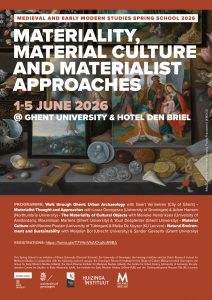
Medieval and Early Modern Studies Spring School 2026 Materiality, Material Culture and Materialist Approaches – Ghent, 1-5 June 2026


This Spring School is organised by Ghent University (Doctoral Schools), the University of Groningen, the Huizinga Institute and the Dutch Research School for Medieval Studies in cooperation with different research groups in the Low Countries. The main aim of this initiative is to stimulate contacts and exchange between PhD candidates and ReMa students in the interdisciplinary field of Medieval and Early Modern Studies bringing them together around a specific theme. The focus for this edition will be on materiality and material culture.

Topic


Material studies is a dynamic and rapidly evolving field in the study of the Middle Ages and the Early Modern Period. It explores the materiality of “objects” (broadly defined), drawing on various disciplines, such as book history, art history, history of science, archaeology and archaeometry. This Spring School examines technical methods, cultural uses of objects and human–object interactions, from daily use to ritual. Materialist and ecocritical perspectives are specifically addressed. Through lectures, workshops and pitches, participants will actively engage with varied approaches to materiality and material culture in historical contexts.

Approaches

This course takes four recent lines of research and the concepts associated with them as a starting point: the study of material culture, of materiality, of ecology & sustainability  and materialist approaches to culture. Nine specialists will engage with the topic from an array of scholarly backgrounds (philosophy, literary studies, history of science, archaeology, medieval history, art history, book history and ecological history). They will reflect on how they define and apply the above-mentioned concepts in their own research. An accompanying reading list underpins further reflection and discussion with the participants. This will offer students a stepping stone to engage with these concepts in relation to their own work, which will also be the topic of short pitches the participants will be expected to deliver. More informal exchange of ideas about the topic of the course will be possible during a thematic walk through Ghent on the first day of the Spring School.

Programme

Session I: Walk through Ghent: Urban Archaeology with Geert Vermeiren (City of Ghent)

Session II & III: – Materialist Thought and Approaches with Laura Georgescu (University of Groningen) and Adam Hansen (Northumbria University)

Session IV & V: The Materiality of Cultural Objects with Marieke Hendriksen (University of Amsterdam), Maximiliaan Martens (Ghent University) and Youri Desplenter (Ghent University)

Session VI & VII : Material Culture with Maxime Poulain (University of Tübingen) and Maïka De Keyzer (KU Leuven)

Session VIII & IX:  Natural Environment and Sustainability with Marjolijn Bol (Utrecht University) and Sander Govaerts (Ghent University)

Registration

PhD students and ReMa students are invited to register for this course before 4 February 2026 through the following link: https://forms.gle/T7YHmVkAKXqXoN9BA  Please note that there is a limited number of places available for this course. After the deadline you will soon receive more information about whether your registration can be confirmed or not. Some of the participating graduate/doctoral schools will cover tuition and lodging for their participating members (please wait for more information after your registration). Students working on Antiquity, or the Modern Period can attend as well but please note that this course will focus mainly on the Middle Ages and the Early Modern Period.

Organising institutions and partners

This Spring School is organised by Ghent University (Doctoral Schools), the University of Groningen, the Huizinga Institute and the Research School for Medieval Studies in cooperation with the following research groups: the Groningen Research Institute for the Study of Culture (Rijksuniversiteit Groningen), the Group for Early Modern Studies (UGent), the Henri Pirenne Institute for Medieval Studies (UGent), the Centre for Urban History (University of Antwerp) the Amsterdam Centre for Studies in Early Modernity (UvA), the Institute for Early Modern History (UGent-VUB) and the Onderzoeksgroep Nieuwe Tijd (KU Leuven).

Organising committee

Marrigje Paijmans (UvA), Elizabeth Merrill (UGent), Bart Ramakers (RUG), Stefan Meysman (UGent), Maïka De Keyzer (KU Leuven), Marlise Rijks (VUB/UGent), Estel van den Berg (UGent) and Kornee van der Haven (UGent).

Venue


Hotel Den Briel and Ghent University
 

This Spring School is organised by Ghent University (Doctoral Schools), the University of Groningen, the Huizinga Institute and the Dutch Research School for Medieval Studies in cooperation with different research groups in the Low Countries. The main aim of this initiative is to stimulate contacts and exchange between PhD candidates and ReMa students in the interdisciplinary field of Medieval and Early Modern Studies bringing them together around a specific theme. The focus for this edition will be on materiality and material culture.

Topic


Material studies is a dynamic and rapidly evolving field in the study of the Middle Ages and the Early Modern Period. It explores the materiality of “objects” (broadly defined), drawing on various disciplines, such as book history, art history, history of science, archaeology and archaeometry. This Spring School examines technical methods, cultural uses of objects and human–object interactions, from daily use to ritual. Materialist and ecocritical perspectives are specifically addressed. Through lectures, workshops and pitches, participants will actively engage with varied approaches to materiality and material culture in historical contexts.

Approaches

This course takes four recent lines of research and the concepts associated with them as a starting point: the study of material culture, of materiality, of ecology & sustainability  and materialist approaches to culture. Nine specialists will engage with the topic from an array of scholarly backgrounds (philosophy, literary studies, history of science, archaeology, medieval history, art history, book history and ecological history). They will reflect on how they define and apply the above-mentioned concepts in their own research. An accompanying reading list underpins further reflection and discussion with the participants. This will offer students a stepping stone to engage with these concepts in relation to their own work, which will also be the topic of short pitches the participants will be expected to deliver. More informal exchange of ideas about the topic of the course will be possible during a thematic walk through Ghent on the first day of the Spring School.

Programme

Session I: Walk through Ghent: Urban Archaeology with Geert Vermeiren (City of Ghent)

Session II & III: – Materialist Thought and Approaches with Laura Georgescu (University of Groningen) and Adam Hansen (Northumbria University)

Session IV & V: The Materiality of Cultural Objects with Marieke Hendriksen (University of Amsterdam), Maximiliaan Martens (Ghent University) and Youri Desplenter (Ghent University)

Session VI & VII : Material Culture with Maxime Poulain (University of Tübingen) and Maïka De Keyzer (KU Leuven)

Session VIII & IX:  Natural Environment and Sustainability with Marjolijn Bol (Utrecht University) and Sander Govaerts (Ghent University)

Registration

PhD students and ReMa students are invited to register for this course before 4 February 2026 through the following link: https://forms.gle/T7YHmVkAKXqXoN9BA  Please note that there is a limited number of places available for this course. After the deadline you will soon receive more information about whether your registration can be confirmed or not. Some of the participating graduate/doctoral schools will cover tuition and lodging for their participating members (please wait for more information after your registration). Students working on Antiquity, or the Modern Period can attend as well but please note that this course will focus mainly on the Middle Ages and the Early Modern Period.

Organising institutions and partners

This Spring School is organised by Ghent University (Doctoral Schools), the University of Groningen, the Huizinga Institute and the Research School for Medieval Studies in cooperation with the following research groups: the Groningen Research Institute for the Study of Culture (Rijksuniversiteit Groningen), the Group for Early Modern Studies (UGent), the Henri Pirenne Institute for Medieval Studies (UGent), the Centre for Urban History (University of Antwerp) the Amsterdam Centre for Studies in Early Modernity (UvA), the Institute for Early Modern History (UGent-VUB) and the Onderzoeksgroep Nieuwe Tijd (KU Leuven).

Organising committee

Marrigje Paijmans (UvA), Elizabeth Merrill (UGent), Bart Ramakers (RUG), Stefan Meysman (UGent), Maïka De Keyzer (KU Leuven), Marlise Rijks (VUB/UGent), Estel van den Berg (UGent) and Kornee van der Haven (UGent).

Venue


Hotel Den Briel and Ghent University

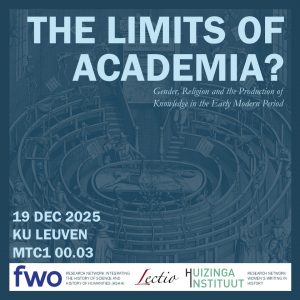
The Limits of Academia?  Gender, Religion and the Production of Knowledge in the Early Modern Period

This LECTIO Junior Initiative explores the production of knowledge in the early modern era, critically examining what defined knowledge as “academic” and why certain forms of inquiry were excluded from universities. It will investigate how processes of inclusion and exclusion shaped knowledge and whether these mechanisms were influenced by factors such as gender, religion, or social status. Additionally, the workshop will foster discussion on whether historiographical categories of “academic” knowledge should be reconsidered.
The goal of this workshop is to introduce LECTIO junior researchers and MA-students to the methodological tools of the history of knowledge through hands-on engagement with primary sources. Participants will explore how the transmission of ideas can be integrated into the history of knowledge, focusing on two key themes: religion and gender. These themes will be examined through three analytical lenses central to the history of knowledge—knowledge actors, circulation, and institutions—providing a structured approach to understanding the complex dynamics of intellectual authority and scholarly traditions.
Programme
09:30–10:00
Registration and coffee
10:15
Welcome and introduction (Richard Calis)
10:30–12:00
Session 1 – Knowledge Actors: The Persona Behind the Academic
  • Speakers: Helena Taylor and Arnoud Visser
  • Moderator: Claire Morrison
12:00–13:00
Lunch Break
13:00–14:30
Session 2 – Circulation: Women and the Production of Theological Knowledge in the Low Countries
  • Speakers: Elise Watson and Patricia Stoop
  • Moderator: Linde Van den Eede
14:30–15:00
Coffee Break
15:00–16:30
Session 3 – Institutions: Religion and Natural Philosophy In/Outside Academia
  • Speakers: Eric Jorink and Steven Vanden Broecke
  • Moderator: Jarrik Van Der Biest
16:30–17:00
Conclusion (Richard Calis)

René Vermeir and Albert Baertsoen at the MSK

René Vermeir is co-curator of the “Albert Baertsoen, ‘le peintre de Gand'” exhibition at the Museum voor Schone Kunsten Gent. It will run until the 27 of November. Baertsoen (1866-1922) was a Belgian painter and printmaker who exhibited at the 1889 Paris Salon. He worked in London during the First World War, and  became a member of the Belgian Royal Academy in 1919.  His works now reside in various private collection, Belgian art institutions, and the Musée d’Orsay, among others. Baertsoen is particularly famed for his impressionistic cityscapes, as well as his masterful depictions of light on both water and snow. René and his colleagues have produced a guide to the exhibition and catalogue raisonné. For more information, please visit the MSK’s website. 

Jonas Roelens on “Not Just the Tudors” podcast

Jonas Roelens has appeared on the highly popular podcast, “Not Just the Tudors,” to discuss female sodomy in the Low Countries. Hosted by the popular public historian, Professor Suzanna Lipscomb, the topics covered included changing perceptions of the female body in relation to fears that were having an active part in penetrative sex.  You can listen to the podcast on Spotify, or by clicking here.

Hugo Soly Book Presentation

We are excited to announce our first in-person meeting in almost three years!

On Wednesday May 25, Hugo Soly will present his latest publication, Capital at Work in Antwerp’s Golden Age, to the IEMH. Dr Soly is professor emeritus of history at the Vrije Universiteit Brussel and a world-renowned expert on pre-industrial labour, poverty, social policies, and successful academic collaboration.

This presentation will take place in the Pirenne lecture hall (UFO, UGent) at 2 pm. Additionally, participants are cordially invited to prepare a short commentary on the book for further discussion. Excerpts will be provided upon request.

If you plan to attend (and/or comment), RSVP before May 23 to Michael Limberger (michael.limberger@ugent.be).

Expo Re/Building Brussels

From February 10 to March 27, the exhibition “Re/Building Brussels” is being held at the Sint-Gorikshallen. It is being curated by IEMH member Heidi Deneweth, and HOST member Matthijs Degraeve. Free tours are offered on March 19 and 22. More information and a sign-up form can be found here.

Critique of UGent’s savings plan

On January 19, 2022, doctoral students at Ghent University published an opinion piece in De Standaard, criticising the recent savings plan proposed by the institution’s administration. An IEMH member, Thomas Donald Jacobs, was among the signatories. You can read it (behind a paywall), here.

Isabelle Devos on Vaccine Inequality

The Quetelet Centre for Quantitative Historical Research, which aims to make large datasets more accessible for investigators, has published another essay by Isabelle Devos. Alongside her work on the 1866 cholera epidemic (which you can read about here), she has also undertaken research on the subject of vaccine distribution and reception. In a blog titled “Viruses know no borders, unfortunately vaccines do,” Devos explores the evolution of smallpox vaccination in nineteenth-century Belgium and the Netherlands. In order to do so, she has made use of a fascinating, but little known source, the annual “Status of Cowpox Inoculation” reports.


‘Coronations and Inaugurations on the Verge of Modernity’ with Klaas Van Gelder

‘Coronations and Inaugurations on the Verge of Modernity.’ Why were inaugurations and coronations so important in early modern Europe and for the Habsburg dynasty in particular? And why were these seemingly anachronistic rituals revived during the revolutionary age that we associate with the birth of modern nation-states? Klaas Van Gelder (State Archives Ghent/Ghent University) will discuss these and other questions with Helen Watanabe-O’Kelly (Oxford University) and Petr Maťa (Austrian Academy of Sciences) to mark the occasion of the recent publication of More than Mere Spectacle: Coronations and Inaugurations in the Habsburg Monarchy during the Eighteenth and Nineteenth Centuries (New York: Berghahn). The talk will be held online, via Teams, on Thursday, May 20, 2021, 17:00-18:00 (Central European Time). Please mail standenenlanden@gmail.com to register before May 19. There will be a Q&A with the speakers and it is free for all participants. You can purchase the book at the publisher’s website, here.

Thomas Donald Jacobs on the International Transgender Day of Visibility

Ghent University has organised a series of events and actions centred on the International Transgender Day of Visibility, held annually on March 31. Among other things, UGent asked scholars working on transgender topics – and transgender researchers – to talk make short videos discussing their work. You can see Thomas Donald Jacobs’s film explaining his doctoral research on early modern diplomatic ceremonial here. Additionally, you can read a blog post by him on “Names and Pronouns in the Classroom,” here.

Jonas Roelens on Radio2

IEMH member, Jonas Roelens, was invited to comment on Lier’s recent apology for witch prosecutions, and the power of gossip and fake news. You can listen to the segment here.

IEMH members at the American Indian Workshop

Two members of the IEMH, Adeline Moons and Jeroen Petit, will present papers at the 41st edition of the American Indian Workshop. Moons’s paper is titled “In search for peace: agency of Esopus Indians in seventeenth century peace negotiations in New England.” Petit’s paper is titled “The Third Anglo-Dutch War and the Articles of Peace between Charles II and several Indian kings and queens.”

This year’s AIW, “Indigenous Shapes of Water & Current Research,” is being hosted by Ludwig-Maximilians University in Munich via Zoom, from November 24-28.  Registration costs 15 EUR and can be done here. The full program can be seen here.

Jonas Roelens, Universiteit van Vlaanderen lecture

Jonas Roelens has given a lecture for the Universiteit van Vlaanderen series, titled “Zijn homo’s verantwoordelijk voor corona?” In the lecture, Dr Roelens discusses the historical scapegoating of the gay community during times of disease.
You can watch the lecture here.

Symposium: “Hospitals and society in the Low Countries”

The IEMH is co-organizing the German Society for the History of Hospitals’s 25th annual Symposium, titled “Hospitals and society in the Low Countries.” This even will take place at Het Pand, on October 4, 2019. Register by contacting Michael Limberger (Michael.Limberger@UGent.be). Registration is free for IEMH members, but there is a 15 euro charge for lunch. Please see the flyer, “Hospitals and society in the Low Countries”, for more information.

The program is as follows:
9.30
Opening by Michael Limberger (Ghent) and Fritz Dross (Erlangen)
10.00
Hadewych Masure (Antwerp):  ‘Hospitals in the Low  Countries as part of the broad landscape of poo relief from ca. 1200 to 1650. Variation, communities and evolutions’
Catrien Santing (Groningen): ‘Medieval Hospitals in Flanders’
Coffee Break
11.30
Martin Scheutz (Vienna) & Alfred Weiß (Salzburg): ‘Die Konfessinalisierung in Flandern mit Berücksichtigung der Hospitäler’
Ton Kappelhof (The Hague): ‘Developments in Hospitals in the Republic and in the Spanish Netherlands’
Christine Vanja (Kassel): ‘Verwirrte und schwermütige Insassen in den grossen Hospitälern der Renaissance – Forschungsstand und offene Fragen’
Thibault Jacobs (Brussels): ‘Founding, Managing or Supporting a Hospital in 14th Century Brabant. Returns on Investments’

Jonas Roelens, in the Vlaamse PhD Cup

Jonas Roelens has been selected to take part in the Vlaamse PHD Cup. As a result, he was recently on Radio 1, talking about ‘badhuizen en brandstapels.’

Listen in at: https://radio1.be/nergens-west-europa-werd-homoseksualiteit-zo-vaak-bestraft-als-laatmiddeleeuws-brugge


Another UGent historian, Lisa Desmets, is also taking part in the competition.


We wish them both the best of luck!

Jonas Roelens, ‘Dé homobeweging is niet in de VS geboren’

On August 8, Jonas Roelens published an editorial in De Standard, titled “Dé homobeweging is niet in de VS geboren.” In it, he properly contextualises the significance of the Stonewall Riots, the anniversary of which was celebrated at many Pride events this past summer.

You can read it here, at De Standard.

Kevin Dekoster on ‘Researching Early Modern History’

Kevin Dekoster recently joined the ‘Researching Early Modern History’ blog.

You can read his first post, “The Sini-Niklaas Child Murder of 1700 and the Scope of Early Modern Forensic Medicine” at:

https://earlymodern.blog/2019/06/21/the-sint-niklaas-child-murder-of-1700-and-the-scope-of-early-modern-forensic-medicine-k-dekoster/

IEMH Gathering, June 3

On June 3, 2019, the VUB is hosting the second IEMH gathering of this academic year.

The following items will be presented:

Paper by Anne Winter (VUB) and Wouter Ryckbosch (VUB): ‘Stedelijke nijverheden en ambachten in 18de-eeuws Vlaanderen & Brabant: Een verkenning aan de hand van de Oostenrijkse enquêtes’

New PhD research by Thomas Jacobs (UGent): ‘The dignity of the state: Diplomatic ceremonial and protocol during the English Civil Wars and Interregnum’

Paper by Arie Van Steensel (Rijksuniversiteit Groningen): ‘Urban Governance and Socio-Economic Development in Late-Medieval Leiden’

Papers will be sent to members in advance. Lunch will be provided, and those wishing to attend are invited to confirm their presence with Jelten Baguet (jelten.baguet@vub.be) by May 20. For further information, please see the program.

International Conference : Social Dynamics in Atlantic Ports, XIVth-XXIst Centuries

Michael Limberger and Anne Winter, among others, are organising an International conference titled “Social Dynamics in Atlantic Ports,  XIVth – XXIst Centuries.” It will take place in Oostende from April 24-26, 2019, and is being hosted by the FLIZ, Flanders Marine Institute. The purpose of the congress is to discuss ports, which were the main nodes in the network that framed the Atlantic world since the XVIth century. They were the focus of commercial life, maritime activities and financial life. These activities created specific social dynamics which characterized port cities. This conference will examine them from the lens of social relations and dynamics on both sides of the Atlantic, north and south. Papers will cover the following areas of interest: social and professional groups; migration and diasporas; social problems and inequality; crime and conflict; public polices; social organisations, networks, and mobility.

For a copy of the conference flyer, click here.
For a copy of the conference information sheet, click here.
For a copy of the preliminary program, click here.

To register, please go to: http://www.vliz.be/atlanticports/